Innistrad: Midnight Hunt (mid) | ||
| #45 ⸱ Uncommon ⸱ Simplified Chinese | ||


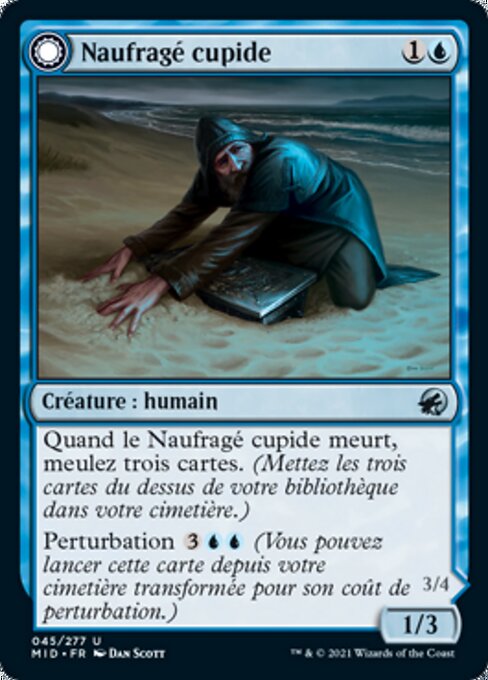


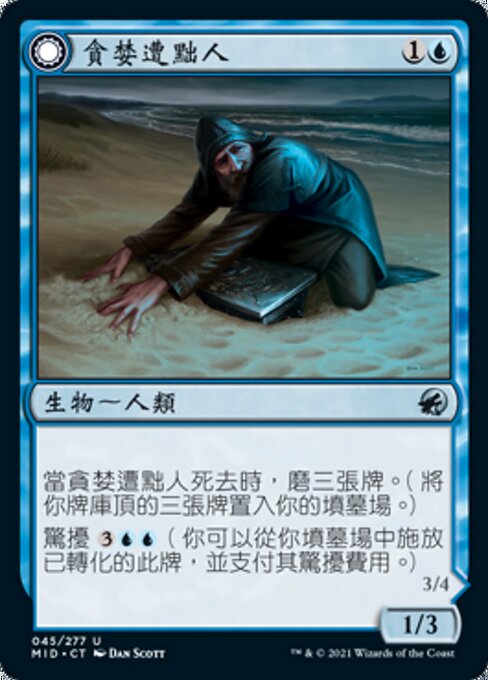
 Variations— Parts— | 贪婪遭黜人
1 / 3 当贪婪遭黜人死去时,磨三张牌。(将你牌库顶的三张牌置入你的坟墓场。) 惊扰   (你可以从你坟墓场中施放已转化的此牌,并支付其惊扰费用。) (你可以从你坟墓场中施放已转化的此牌,并支付其惊扰费用。)
魂魅涤除灵3 / 4 飞行 当魂魅涤除灵进战场时,你可以将至多三张目标牌从你的坟墓场洗入你的牌库。 如果魂魅涤除灵将从任何区域进入坟墓场,则改为将它放逐。
LegalitiesNot Legal Alchemy Future Oldschool Pauper Paupercommander Penny Predh Premodern Standard Standardbrawl Legal Brawl Commander Duel Gladiator Historic Legacy Modern Oathbreaker Pioneer Timeless Vintage Rulings“Disturb [cost]” means “You may cast this card transformed from your graveyard by paying [cost] rather than its mana cost.”
If you copy a permanent spell cast this way (perhaps with a card like Double Major), the copy becomes a token that's a copy of the card's back face, even though it isn't itself a double-faced card.
When you cast a spell using a card's disturb ability, the card is put onto the stack with its back face up. The resulting spell has all the characteristics of that face.
To determine the total cost of a spell, start with the mana cost or alternative cost (such as a disturb cost) you're paying, add any cost increases, then apply any cost reductions. The mana value of a spell cast using disturb is determined by the mana cost on the front face of the card, no matter what the total cost to cast the spell was. (This is a special rule that applies only to transforming double faced-cards, including ones with disturb.)
Disturb is found only on the front faces of some double-faced cards.
A spell cast this way enters the battlefield with its back face up.
The back face of each card with disturb has an ability that instructs its controller to exile if it would be put into a graveyard from anywhere. This includes going to the graveyard from the stack, so if the spell is countered after you cast it using the disturb ability, it will be put into exile.
| Market Pricing
Printings
| |||||||||||||||||||||||||||||||||
