Lorwyn Eclipsed (ecl) | ||
| #239 ⸱ Rare ⸱ Spanish | ||
 Variations— Parts— | Planes de asalto
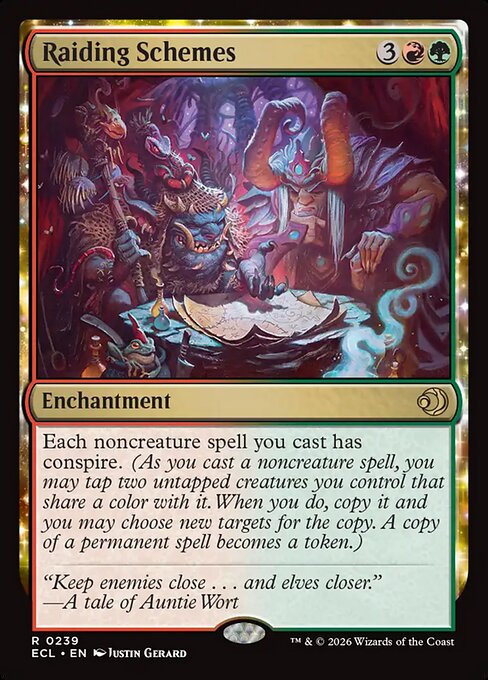
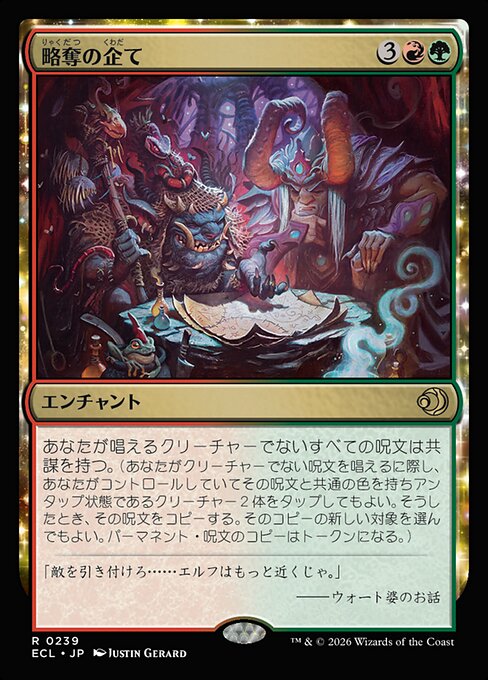
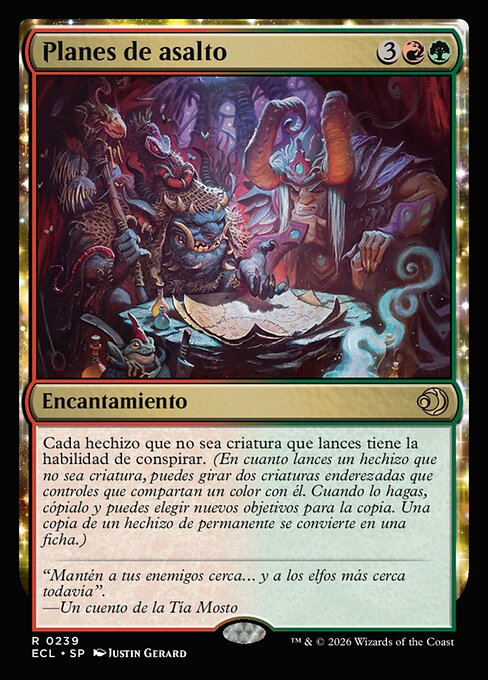
Cada hechizo que no sea criatura que lances tiene la habilidad de conspirar. (En cuanto lances un hechizo que no sea criatura, puedes girar dos criaturas enderezadas que controles que compartan un color con él. Cuando lo hagas, cópialo y puedes elegir nuevos objetivos para la copia. Una copia de un hechizo de permanente se convierte en una ficha.)
LegalitiesLegal Duel Brawl Penny Future Legacy Modern Alchemy Pioneer Vintage Historic Standard Timeless Commander Gladiator Oathbreaker Standardbrawl Not Legal Predh Pauper Oldschool Premodern Paupercommander Tlr RulingsIf the spell has any targets, the copy will have the same targets unless you choose new ones. You may change any number of the targets, including all of them or none of them. The new targets must be legal.
You can't choose to pay any additional costs for the copy. However, effects based on any additional costs that were paid for the original spell are copied as though those same costs were paid for the copy too.
The copy is created on the stack, so it's not "cast." Abilities that trigger when a player casts a spell (such as conspire's triggered ability that creates a copy of the spell) won't trigger.
If the copied spell divides damage or distributes counters among a number of targets, the division and number of targets can't be changed. If you choose new targets, you must choose the same number of targets.
If a spell has multiple instances of conspire (perhaps from multiple Raiding Schemes), you may choose to pay for each of those abilities individually. Each conspire ability triggers only if you tap two creatures specifically for that ability.
A resolving copy of a permanent spell becomes a token. That token isn't "created" and won't interact with abilities that care about tokens being created.
If the spell that's copied has an X whose value was determined as it was cast, the copy will have the same value of X.
If the spell that's copied is modal (that is, it says "Choose one —" or the like), the copy will have the same mode or modes. You can't choose different ones.
| Market Pricing
Printings
| |||||||||||||||||||||||||||||||||