Murders at Karlov Manor (mkm) | ||
| #201 ⸱ Uncommon ⸱ Japanese | ||


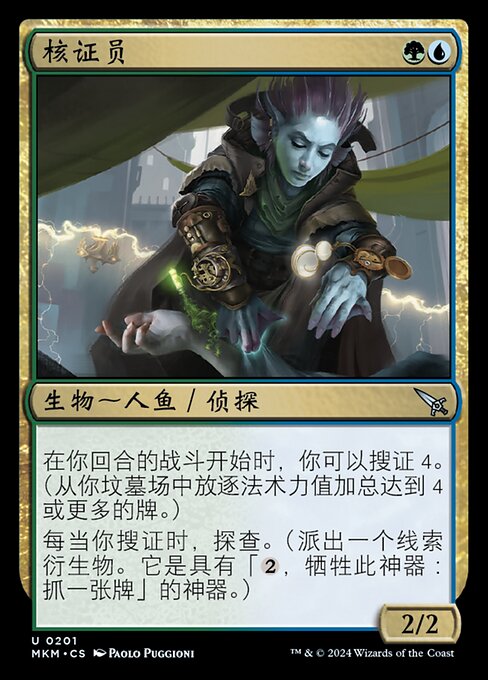
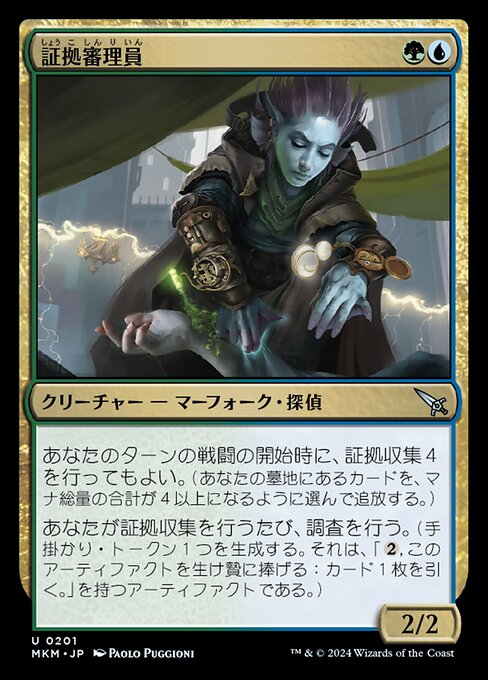 Variations— Parts— | 証拠審理員
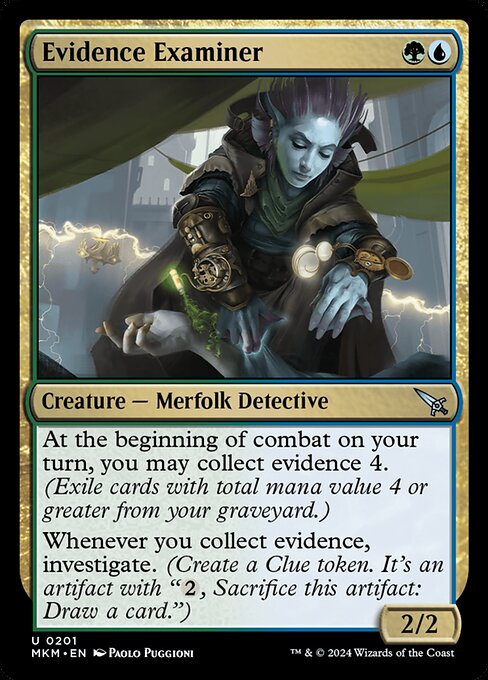
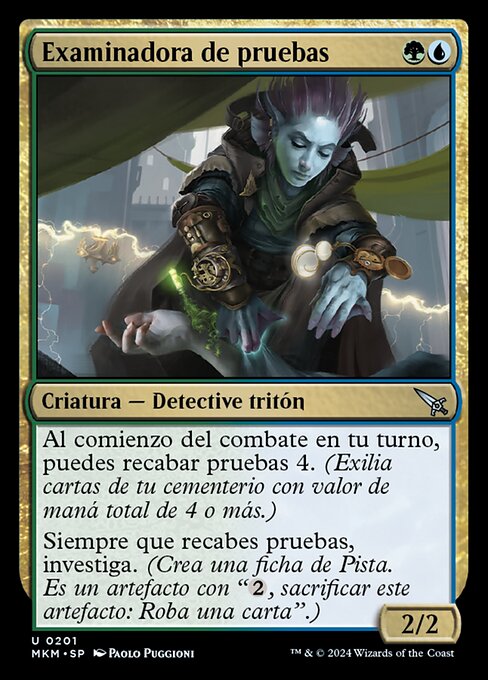
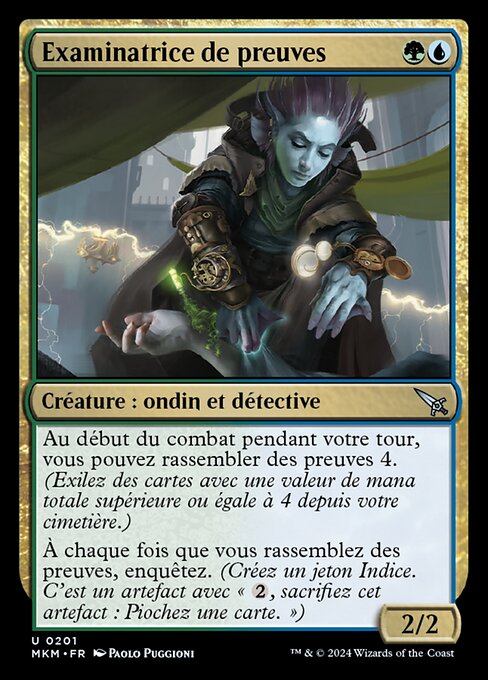
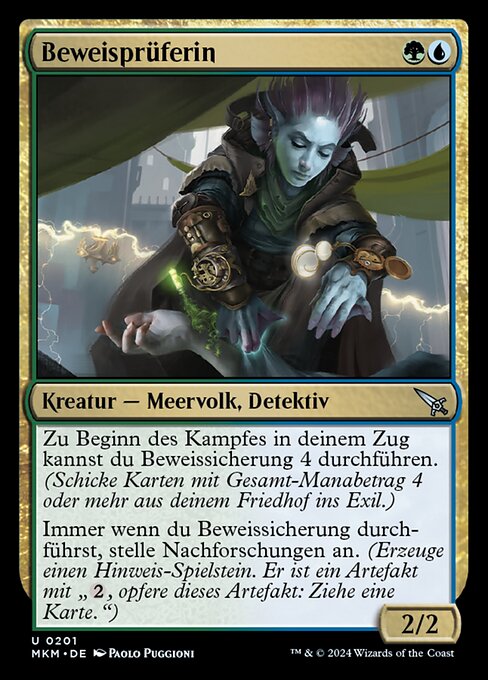
2 / 2 あなたのターンの戦闘の開始時に、証拠収集4を行ってもよい。(あなたの墓地にあるカードを、マナ総量の合計が4以上になるように選んで追放する。) あなたが証拠収集を行うたび、調査を行う。(手掛かり・トークン1つを生成する。それは、「  , このアーティファクトを生け贄に捧げる:カード1枚を引く。」を持つアーティファクトである。) , このアーティファクトを生け贄に捧げる:カード1枚を引く。」を持つアーティファクトである。)
LegalitiesNot Legal Alchemy Oldschool Pauper Paupercommander Penny Predh Premodern Legal Brawl Commander Duel Future Gladiator Historic Legacy Modern Oathbreaker Pioneer Standard Standardbrawl Timeless Vintage RulingsIf an effect refers to a Clue, it means any Clue artifact, not just a Clue artifact token. For example, you can sacrifice Wrench to pay for Alquist Proft, Master Sleuth's activated ability.
Clue is an artifact type. Even though it appears on some cards with other permanent types, it's never a creature type, a land type, or anything but an artifact type.
If you can't exile enough cards to meet or exceed the required mana value, you can't choose to collect evidence at all.
You can't sacrifice a Clue to pay multiple costs. For example, you can't sacrifice a Clue token to activate its own ability and also to activate Alquist Proft, Master Sleuth's ability.
Some spells and abilities that investigate may require targets. If each target chosen is an illegal target as that spell or ability tries to resolve, it won't resolve. You won't create any Clue tokens.
Once you've announced that you're casting a spell, players can't take actions until you've finished doing so. Notably, opponents can't try to remove cards from your graveyard to stop you from collecting evidence.
Some abilities trigger "whenever you sacrifice a Clue". Those abilities trigger whenever you sacrifice a Clue for any reason, not just to activate a Clue's activated ability.
Evidence Examiner's last ability triggers whenever you collect evidence for any reason, not just when you collect evidence with its first ability.
| Market Pricing
Printings
| |||||||||||||||||||||||||||||||||